
A US federal court has refused LEGO's attempt to dispose of an artist's copyright claims over the miniature version of the artwork he added to Antoni Porowski's leather jacket, later worn on Queer Eye, in a ruling that turns on the difference between owning an object, licensing a person's likeness and holding the copyright in what that person wears.
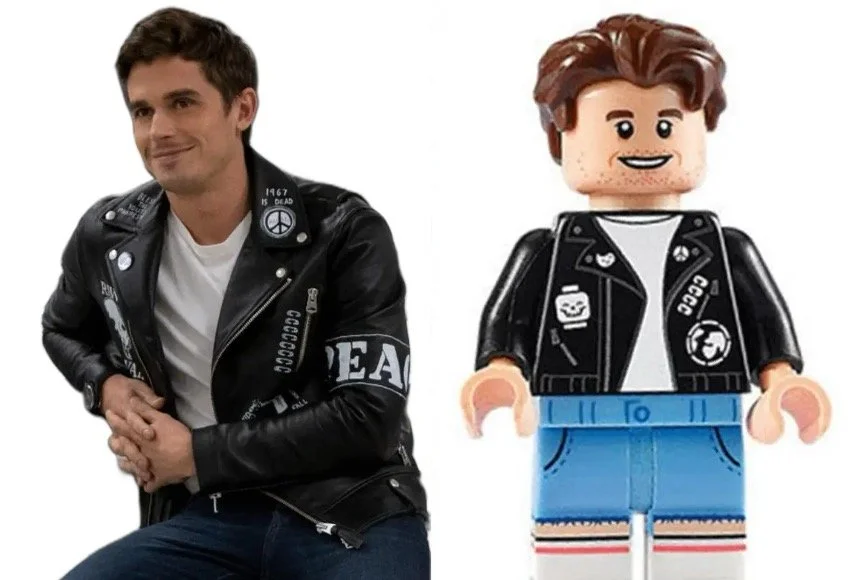
Antoni Porowski wearing the jacket on Queer Eye (left) and his minifigure in LEGO's The Fab 5 Loft set (right). Images: Netflix (background edited); LEGO.
On 27 September 2026, Judge Omar A. Williams of the United States District Court for the District of Connecticut denied LEGO's motion for summary judgment on the copyright claims brought by the artist James Concannon, whose artwork on a leather jacket worn by Antoni Porowski on Netflix's Queer Eye reappeared in miniature on Porowski's minifigure in LEGO's licensed set, The Fab 5 Loft. All three of Concannon's copyright claims, for direct, contributory and indirect infringement, will proceed, as will his claim under the Connecticut Unfair Trade Practices Act. LEGO succeeded only in having the trade dress claim dismissed, and the parties have until 30 October 2026 to inform the court whether they have resumed settlement discussions or to propose a trial schedule.
The procedural posture is important to an accurate reading of the decision. In seeking summary judgment, LEGO asked the court to find that there was no genuine dispute of material fact on which a jury could find in Concannon's favour, and that its defences were sufficient to end the claims without a trial. The court's refusal is not a finding that LEGO infringed Concannon's copyright, nor does a ruling of a single district court at this stage settle the law beyond the case itself. It is, however, a finding that Concannon's claims are capable of succeeding before a jury, and that neither of the two defences on which LEGO principally relied, an implied licence arising from the gift of the jacket and fair use, was sufficient to dispose of them.
Garments are routinely given to public figures, worn on screen and photographed, often without any formal agreement about what may later be done with them. The record in this case is notable because it contains both practices side by side. For earlier pieces Concannon made for Porowski, the show's producers obtained signed releases setting out what could be shown and on what terms; for the jacket, no release was sought at all. What makes the decision worth close attention is the question that the absence of any such agreement left open, and which the court was required to answer. When a brand acquires the right to depict a person, how much of what that person wears does the right carry with it?
The jacket, the licence and the design process
Concannon's relationship with the show began on a formal footing. According to his complaint, as summarised by the court in 2023, Netflix sought his permission for Porowski to wear four of his pieces in the first season, and he signed a release granting the production company the right to feature them on the show and in its advertising. As further pieces appeared over the following years, the producers, in the words of the complaint, "obtained a signed release specifying the Product that would appear on the show and the nature of the rights being granted".
In 2018, Porowski commissioned Concannon to adorn a black leather jacket for him, and Concannon added his artwork to Porowski's own jacket before returning it. Porowski told him when he would be filming, and the two discussed elements that Netflix might find unpalatable. The court observed that "it appears that Plaintiff produced the jacket with an eye toward making it available for Mr. Porowski to wear on the show", although Concannon denies that it was made specifically for that purpose and testified that it was a gift.
The jacket is densely worked in slogans and graffiti-style motifs, with "THYME IS ON MY SIDE" across the back, described in the complaint as a "play on Mr. Porowski's interest in food and cooking", set over the word "thyme" repeated in script so small that it reads as a textured ground. Concannon later registered copyright in those elements, covering their use, combination and arrangement as well as the elements themselves.
Porowski wore the jacket on the show, but on this occasion no release was sought. According to the complaint, Concannon was "not disturbed" at the time because he "figured this was simply an oversight on Netflix's part", given that the production had previously asked his permission and credited him.
In 2020, LEGO obtained a licence of Queer Eye intellectual property, including the likenesses of the five hosts, and began designing the set. The Porowski minifigure was given a black jacket printed with a peace sign, a skull, safety pins, a smiling teardrop and, on the back, the words "REBUILD THE WORLD" in graffiti-style lettering over a grey ground. Concannon was neither consulted nor asked for a licence.
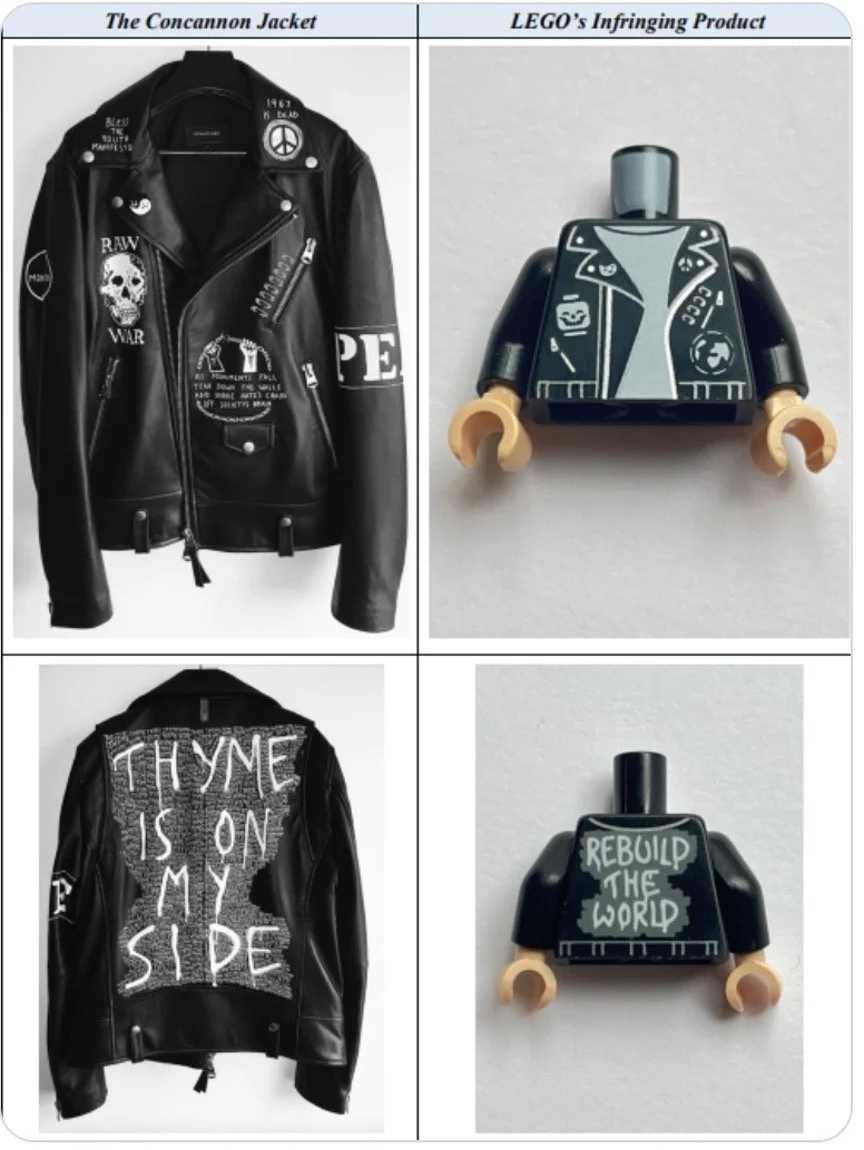
Concannon's jacket (left) and the minifigure jacket (right), front and back. Image: Third Amended Complaint, Concannon v LEGO Systems, Inc. (D. Conn.)
The court's account of the design process contains what may prove to be the most consequential detail in the record. LEGO's originally proposed version reproduced "THYME IS ON MY SIDE" in Concannon's lettering. LEGO "initially wanted to retain this phrase", but following discussions between its own legal department and Scout Productions, the show's production company, the words were changed to a LEGO slogan, "REBUILD THE WORLD". The ruling does not record what prompted the change. The court noted that the originally proposed jacket "clearly attempted to reproduce Plaintiff's writing exactly", paint drips included, and that the font and the original drips remained through production and sale of the set. LEGO characterised its version as "chunkier" and "more cartoony", consistent with what it described as its "LEGO DNA", although the court observed that it was debatable whether the images supported that characterisation. Nor was the resemblance confined to the back. Comparing the two jackets element by element, the court considered that a reasonable factfinder "could (and likely would easily)" conclude that the adornments and their placement strongly resembled those on Porowski's jacket, observing that the skull on the right breast had simply been made into a minifigure skull. LEGO's omission of much of Concannon's text did not alter that assessment, since LEGO, while altering the content, had kept Concannon's "aesthetic, the general elements of the adornments, and the placement of the same", which it needed in order for the minifigure's jacket to be recognisable as Porowski's.
The commission, the gift and the question of implied licence
LEGO's first defence depended on a chain of permissions, and the commission gave it a respectable foundation. Concannon, it argued, had granted Porowski an implied, non-exclusive licence to use the jacket as part of his public persona, Porowski's likeness had been licensed to the show's producer, and that licence had in turn been extended to LEGO, so that the right to depict the artwork travelled with the right to depict the man.
Courts in the Second Circuit have used two tests for implied licences, although the Court of Appeals has endorsed neither. Under the narrower, a licence may arise where a work is created at another's request and handed over with the intention that it be copied and distributed, and Concannon had, on the evidence, adorned the jacket at Porowski's request, knowing when it would appear on screen. The court did not find it necessary to decide which of the two tests applied, that narrower test or the broader approach under which consent may be inferred from the owner's knowledge of and acquiescence in a use, because both require a meeting of the minds and the evidence disclosed none. The material LEGO relied upon, including Concannon's exchanges with Porowski and his deposition testimony, established only what had already been accepted when the case survived LEGO's motion to dismiss in 2023: that the jacket was given freely, that Concannon knew it would be worn in public and on television, and that he raised no objection to its appearance on the show. Those facts were, in the court's view, more consistent with "a limited license to wear the jacket on the show and in public appearances, not an unlimited license to copy and redistribute it more widely". The record was, moreover, silent on what Porowski himself understood his rights to be, which was significant given that the argument depended on the understanding of both parties to the supposed licence, and the earlier observation that any implied licence would in any event have been revoked by the commencement of proceedings remained unanswered.
The analysis is a useful corrective to the intuition that a piece made at a public figure's request, and given in the knowledge that it will be seen widely, carries with it a broad permission. Knowledge that a work will be displayed is not the same as consent to its reproduction, and the court treated the scope of the permission as defined by what was actually contemplated when the jacket changed hands, rather than by the commercial value it later acquired.
The tattoo cases and the line the court drew
LEGO's principal authority was Solid Oak Sketches v 2K Games (S.D.N.Y. 2020), in which the reproduction of real basketball players' tattoos in the NBA 2K video games was held not to infringe the copyright of the tattoo artists. The analogy had an evident appeal, since both cases concerned an artist's work closely associated with a public figure and later reproduced in a licensed product built around that figure. The court nonetheless declined to follow it, noting that it was a district court decision without precedential force, that the tattoo artists in that case had accepted that they intended their work to become part of the players' likenesses, and that a tattoo, permanently affixed to the body, is appreciably different from an item of clothing that can be removed, sold or displayed independently of its wearer. The court also observed that the Second Circuit has decided several relevant fair use cases since Solid Oak was handed down.
The distinction between the permanent and the removable is persuasive on these facts, but it also raises a question the judgment did not need to answer. Some garments and accessories become so closely identified with a public figure that they function, in practice, as part of that person's recognisable image: a signature look, a costume, a piece worn so consistently that the person is rarely seen without it. Whether a court would treat such an item more like the tattoos in Solid Oak than the jacket in this case is a question that studios recreating real people in games, toys and digital environments may wish to consider before a court is asked to decide it.
Fair use, accurate depiction and the market for derivative works
The court found that every fair use factor favoured Concannon. On the first, the purpose and character of the use, LEGO gave two purposes for the minifigure jacket, depicting Porowski accurately and promoting its collaboration with the show, and proposed no broader public purpose. The court treated the use as commercial.
LEGO argued that reproducing the jacket was a "factual" use, needed to portray Porowski accurately. The court was not persuaded: a use intended simply to reproduce a work "appears to be a purely substitutive purpose, and therefore by definition not transformative". It distinguished Bill Graham Archives v Dorling Kindersley (2d Cir. 2006), where poster and ticket images were reproduced to illustrate a biography of the Grateful Dead, observing that the set "does not have any of the secondary purposes listed in the Act".
The court then asked whether there was any justification for copying at all, drawing on Andy Warhol Foundation v Goldsmith. It found that the minifigure jacket offered no commentary on the original, and that "simply taking another artist's work and applying the 'LEGO DNA' to it does not qualify as justification".
On market harm, LEGO argued that Concannon had no realistic prospect of entering the global toy market and that his licensing business had been unaffected. The court rejected that argument by reference to the copyright owner's control over derivative works, including the decision whether such works should be made at all, and placed the burden of demonstrating the absence of harm to that market on LEGO. It observed that, in the case of a one-of-a-kind work, derivative uses are likely to represent the principal means by which an artist could exploit it, and concluded: "It cannot be that LEGO is free to use any artist's original works as long as those artists are not likely to enter the toy market and do not mass-produce their products." For independent designers and artists, whose work is frequently unique and whose most valuable rights may lie in markets they have not yet entered, that reasoning is of considerable significance.
Concannon had described the harm in terms familiar to anyone working in fashion well before this ruling. In his third amended complaint, as recorded in Judge Arterton's March 2023 decision on LEGO's motion to dismiss, he alleged that his "business and livelihood have been threatened" because he "relies on the exclusivity and distinctiveness of his designs" to sell his products. At that stage the court held that he had alleged harm to the market for his products "in the form of the loss of royalties for this specific LEGO Jacket, the harm to the exclusivity and consumer view of his products, and the future harm because of the risk that other companies will follow Defendant's lead and use his products in different markets without paying licensing fees".
The position in the UK
Had the dispute arisen in the UK, the analysis would have proceeded from a different starting point. English law has no general fair use defence, and LEGO would have been required to bring its use within one of the specific permitted acts in the Copyright, Designs and Patents Act 1988, such as criticism or review, quotation, or caricature, parody and pastiche, each of which is also subject to a requirement that the dealing be fair. It is difficult to see how the commercial reproduction of a jacket's artwork on a toy could be accommodated within any of them, and the pastiche exception, which might be thought the most promising, remains largely untested in the English courts.
The protection of the artwork itself would not be in serious doubt. Response Clothing v Edinburgh Woollen Mill [2020] EWHC 148 (IPEC), in which the copying of a fabric design was held to infringe, is a reminder that garments may carry protected work even where the garment itself is not the subject of protection.
Implications for licensing practice
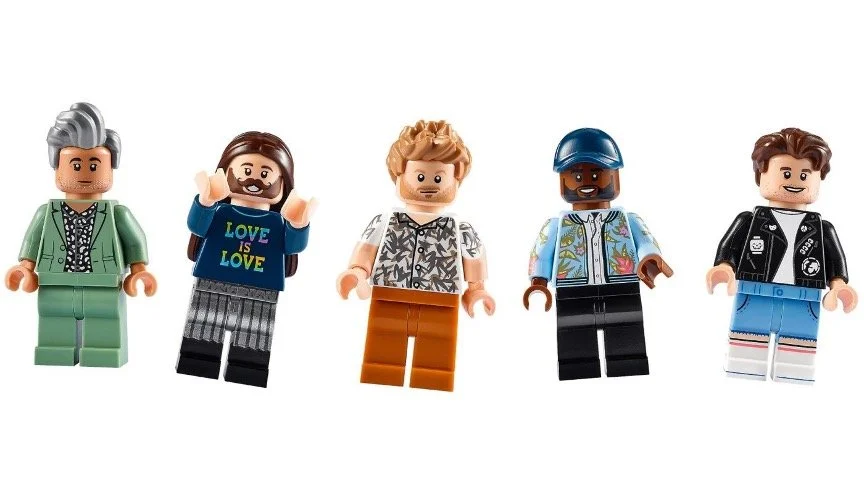
The five Queer Eye hosts as minifigures in The Fab 5 Loft. Image: LEGO.
Read with appropriate caution, as a first-instance ruling at the summary judgment stage, the decision nonetheless suggests several points of practical relevance. For brands licensing the likenesses of public figures, it indicates that rights clearance may not end with the person depicted: where a product is designed to recreate a figure accurately, the clothing, accessories and artwork associated with that figure may belong to third parties, and a licence granted by a production company, agency or the individual will not necessarily extend to them. For artists and designers who dress public figures, it illustrates how much may depend on what is recorded when a piece changes hands, since a short written statement of what the recipient may and may not do would likely have narrowed the questions now before the court. And for studios that recreate real people in toys, games or digital form, it suggests that Solid Oak may offer less protection than has sometimes been assumed, at least where the artwork in question is not fixed to the body.
Whether LEGO infringed Concannon's copyright now falls to be determined by a jury, unless the parties settle in the meantime. Whatever the outcome, the ruling has already drawn a distinction of wider interest in a market increasingly built on the commercial value of personality: a licence to depict a person does not, without more, carry with it a licence of everything that person wears.
Sources
Primary
· Concannon v LEGO Systems, Inc., Ruling Denying in Part Motion for Summary Judgment, No. 3:21-cv-01678 (OAW) (D. Conn., 27 September 2026)
· Concannon v LEGO Systems, Inc., Ruling on Motion to Dismiss and Motion to Seal, No. 3:21-cv-01678 (JBA) (D. Conn., 15 March 2023)
· Solid Oak Sketches, LLC v 2K Games, Inc., 449 F. Supp. 3d 333 (S.D.N.Y. 2020)
· Bill Graham Archives v Dorling Kindersley Ltd, 448 F.3d 605 (2d Cir. 2006)
· Andy Warhol Foundation for the Visual Arts, Inc. v Goldsmith, 598 U.S. 508 (2023)
· Copyright, Designs and Patents Act 1988, ss. 30, 30A
· Response Clothing Ltd v Edinburgh Woollen Mill Ltd [2020] EWHC 148 (IPEC)