
Paris Court Annuls Kering and Bottega Veneta Application to Remove "Made in Italy" Video

Image: Bottega Veneta via YNAP
Kering and Bottega Veneta sought an order requiring Meta to remove a video questioning how luxury goods may qualify for “Made in Italy” labelling. The Paris Judicial Court annulled the summons without deciding whether the video was accurate or defamatory, or whether the handbag shown was a counterfeit of Bottega Veneta’s Jodie design.
“Made in Italy” is more than a statement of geography in luxury. It carries associations of craftsmanship, provenance and value. The legal rules by which origin is attributed to goods manufactured across several countries, however, may not always correspond with what consumers understand the label to mean.
On 16 May 2025, Istok Pavlovic, a Serbian content creator reported at the time to have approximately 540,000 followers, published a video in English on Instagram and Facebook under the title “So easy to trick you”. In it, Pavlovic refers to the European Union’s non-preferential rules of origin and presents what he describes as a common industry practice: that a luxury product may carry a “Made in Italy” designation even where most of its manufacture took place outside Europe, provided that the processing undertaken in Italy is sufficient to establish Italian origin.
He illustrates the proposition through a staged example. A woven handbag is presented as having been imported from China for $20. Following a final operation in Italy, its “Made in China” label is replaced with one reading “Made in Italy”, while the stated price rises to $2,000.
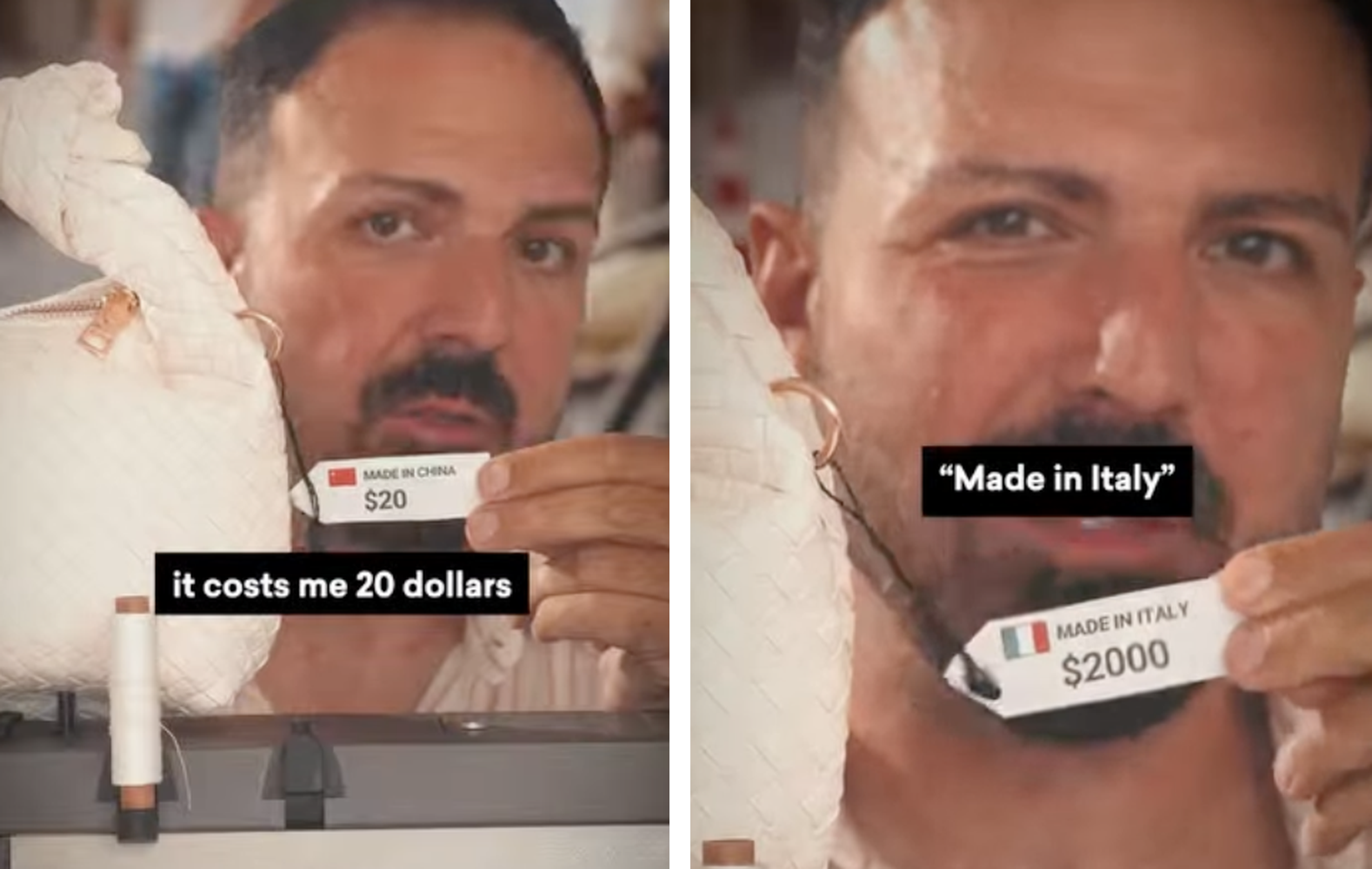
Pavlovic’s staged illustration of a handbag moving from a “Made in China” label and stated price of $20 to a “Made in Italy” label and stated price of $2,000. The court made no finding that the example represented Bottega Veneta’s manufacturing practices. Stills: Istok Pavlovic/Instagram, 16 May 2025.
Pavlovic links his demonstration to Article 60 of the Union Customs Code. Under that provision, where production involves more than one country, the relevant operation must constitute the last substantial, economically justified processing or working, carried out in an undertaking equipped for that purpose, and result in the manufacture of a new product or represent an important stage of manufacture. The EU’s non-preferential origin rules also exclude certain minimal operations from conferring origin.
As Pavlovic speaks, he handles a handbag that Kering, Bottega Veneta France and Bottega Veneta S.R.L. identified as a counterfeit of the Jodie. The companies told the court that the model is manufactured in Italy by specialist artisans and considered that the video infringed their rights. The judgments record Pavlovic’s account but do not determine whether his interpretation of the rules was correct, whether the handbag followed the production history presented in the video or make any finding concerning Bottega Veneta’s manufacturing practices.
The application against Meta
Kering and the Bottega Veneta initially reported the video to Instagram and Facebook. When it remained online, they sent formal demands to Meta Platforms Ireland and Pavlovic before commencing proceedings on 3 July 2025. The companies asked the Paris Judicial Court under the accelerated procedure on the merits, to order Meta to remove the publication from both platforms. Pavlovic was formally made a defendant, although no damages or other personal order were sought against him. Meta appeared through counsel and left the merits of the application to the court, while Pavlovic did not instruct a lawyer and did not appear.
The application was brought under Article 6-3 of France’s Law for Confidence in the Digital Economy of 21 June 2004, known as the LCEN. The provision permits the Court to prescribe measures against any person capable of contributing to the prevention or cessation of harm caused by content made available through an online public communication service.
The case was not presented as a conventional defamation action. Defamation nevertheless formed part of the alleged harm, alongside the presentation of a purportedly counterfeit product, disparaging statements and the publication of false information. Kering and Bottega Veneta maintained that their Article 6-3 application was autonomous from proceedings under France’s Law of 29 July 1881 on freedom of the press. Their request was formally directed at Meta and sought only the removal of the video, while Pavlovic’s inclusion in the proceedings was described as incidental.
Why the 1881 Law applied
The court accepted that an application under Article 6-3 may remain autonomous from a defamation action where it does not target a person whose liability could be pursued under Article 42 of the 1881 Law or Article 93-3 of the Law of 29 July 1982. That condition was not satisfied here. Pavlovic had been formally summoned and was a party to the proceedings. Although no relief was sought against him personally, the order requested would have brought publication of his video to an end.
The court observed that removal of a publication may itself be ordered as a form of reparation for defamation and would affect Pavlovic’s freedom of expression. He therefore had to remain able to rely upon the defences and procedural protections available under the 1881 Law, notwithstanding that he had not appeared to invoke them.
The court treated the 1881 Law as a special statute of public order which, in the circumstances, prevailed over Article 6-3 of the LCEN as a more general provision. The proceedings were consequently subject to Article 53 of the 1881 Law.
Article 53 imposes formal requirements upon proceedings concerning alleged press offences. The originating document must identify and legally characterise the statements complained of, specify the applicable legal provision, elect a procedural address in the town in which the court sits and be notified to the public prosecutor as well as the defendant. The summons had not been notified to the public prosecutor before the first hearing.
Neither Meta nor Pavlovic had initially raised the issue. Following the hearing on 20 January 2026, the court reopened the proceedings of its own motion on 26 February and invited the parties to address whether the summons complied with Article 53.
Kering and the Bottega Veneta companies maintained that the provision did not apply because the application had been brought under the LCEN, sought no finding that Pavlovic had committed a press offence and requested relief only against Meta. The court rejected that position.
The nullity did not stop at the defamation element. The summons contained one substantive request, the removal of Pavlovic’s video, supported by several alleged wrongs, including defamation. Because that request could not be divided, the failure to comply with Article 53 affected the summons in its entirety.
On 9 July 2026, the court annulled the summons and left each party to bear its own costs. The judgment was delivered at first instance and is open to appeal.
What the judgment leaves unresolved
The court did not decide whether Pavlovic’s account of European origin law was accurate, whether the practice he described occurs within luxury manufacturing, whether the handbag shown was counterfeit or whether the video was defamatory. It also made no finding concerning Bottega Veneta’s manufacturing practices. The substantive disagreement therefore remains open.
Pavlovic’s proposition was not simply that luxury goods are manufactured internationally. His video questioned the relationship between legal origin and the commercial meaning of provenance. Customs law provides a framework for assigning origin to products whose manufacture crosses borders. Consumers encountering “Made in Italy” may read the same words more broadly, as a statement about where a product was principally made, the labour involved and the craftsmanship for which they are paying.
The staged movement from a $20 imported bag to a $2,000 Italian-labelled luxury product condensed that distinction into an argument about value. Article 60, however, requires a product-specific assessment against the relevant rules and the nature of the processing undertaken. For goods not covered by a specific product rule, origin may need to be determined on a case-by-case basis by reference to the last substantial processing or working, as explained in the European Commission’s guidance on non-preferential origin.
Kering and Bottega Veneta were also responding to the use of what they considered a counterfeit version of a recognisable House design. A product made without the brand’s authority cannot establish how an authentic Jodie is manufactured. Used as the visual centre of the video, however, it could lead viewers to associate Pavlovic’s wider allegations directly with Bottega Veneta.
Once the companies sought the judicial removal of that commentary, alleged defamation formed part of the asserted harm, Pavlovic had been formally made a defendant and removal of his publication was the sole remedy requested. Those features brought the application within the procedural safeguards of the 1881 Law before the underlying allegations could be examined.
The judgment does not prevent brands from pursuing defamatory statements, false allegations or content involving counterfeit products. It requires the proceedings to observe the legal framework applicable to the complaint as it has been constituted. The first-instance judgment is open to appeal. It does not determine whether the underlying complaints could be pursued through proceedings constituted differently and compliant with the applicable formalities.
Editorial note: This article is based on the Paris Judicial Court’s interlocutory judgment of 26 February 2026 and final judgment of 9 July 2026 in proceedings RG no. 25/54633. The February judgment identifies Bottega Veneta France and Bottega Veneta S.R.L., while the published final judgment pseudonymises the Bottega Veneta entities and the individual defendant. Pavlovic’s identity and the reported follower figure are drawn from press reporting rather than the published judgments reviewed for this article. The final judgment was given at first instance and remains open to appeal.