
Why Would Dior Turn a Children's Book into a £3,000 Handbag?
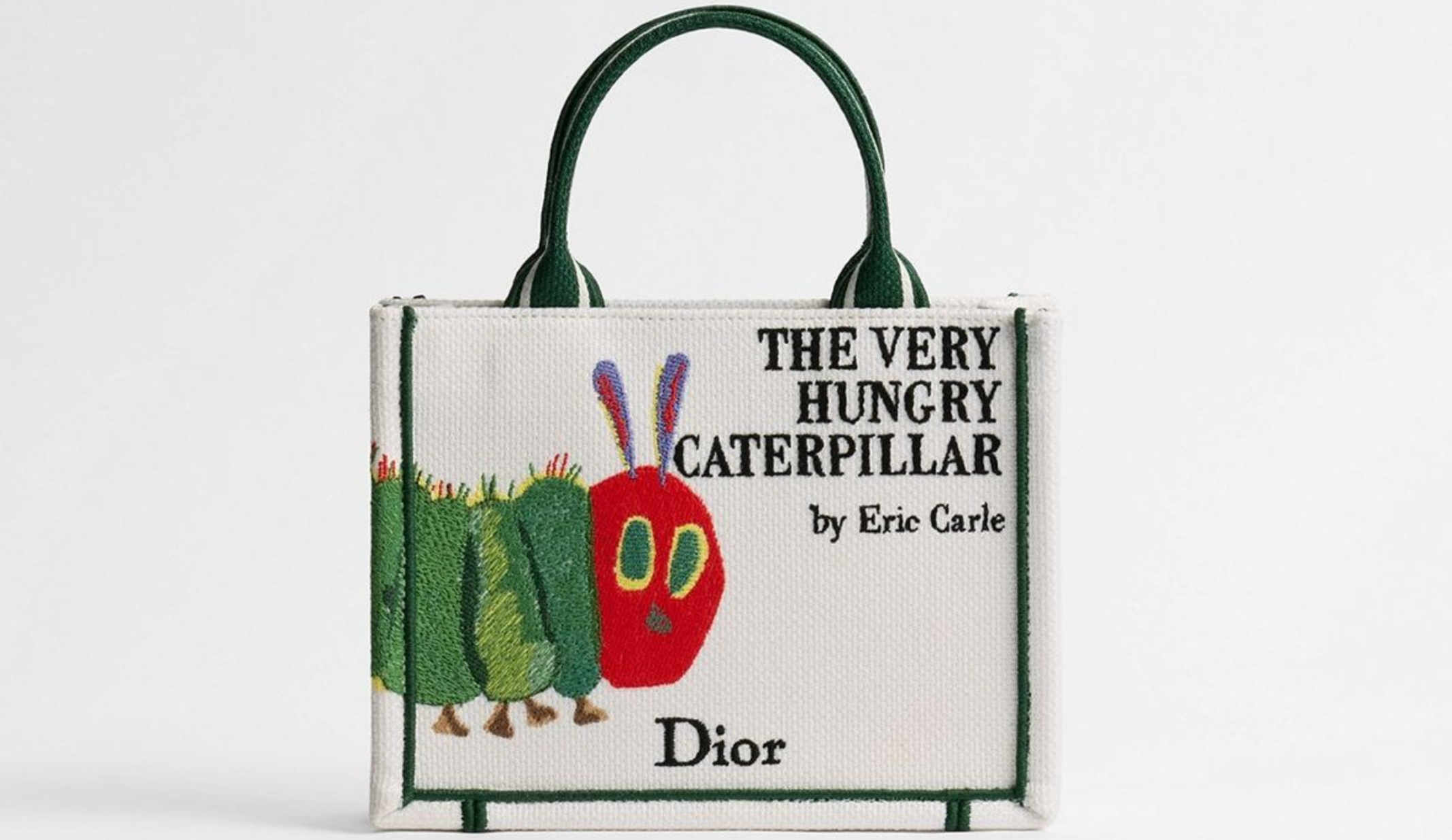
Dior Book Tote from the Very Hungry Caterpillar collection. Image: Dior
On Dior's Very Hungry Caterpillar collection, what intellectual property law actually does, and where luxury value comes from.
As a mother of two young boys, The Very Hungry Caterpillar is one of those books that has lived many lives in our home. It has been a bedtime story, a favourite on long journeys, and, for me, one of the first books I can recall reading as a child myself. That is partly why Dior's latest collaboration immediately caught my attention.
Under the creative direction of Jonathan Anderson, and working with The World of Eric Carle, the organisation that manages the rights to Carle's work, Dior transformed the 1969 picture book, written and illustrated by Carle himself, into a 23-piece capsule collection spanning Dior Book Totes, knitwear, T-shirts, slippers, bag charms and a blanket, with prices ranging from under £100 for the smaller accessories to nearly £3,000 for the medium Book Tote. The collection reached Dior boutiques worldwide on 28 May, after months of anticipation built through previews at Anderson's Dior shows.
It is playful and unexpected, and it found its way onto the front row almost immediately. Macaulay Culkin himself a figure of enduring childhood nostalgia, wore the caterpillar sweater to a Dior show in Paris earlier this year, and the image travelled well beyond the fashion press. Yet its significance lies beyond the novelty of seeing a children's book translated into luxury fashion.
Why would Dior turn a children's book into a luxury handbag?
The answer, on the surface, is intellectual property. But not in the way fashion lawyers typically discuss it. Conversations about fashion law tend to focus on disputes; trade mark infringement, counterfeiting, copyright claims, enforcement. Important as these are, they can obscure a different function IP law performs, one that has little to do with policing and everything to do with creating opportunity.
The Very Hungry Caterpillar is, at its core, a creative work still protected by copyright. Carle died in 2021, and in the UK, as in most jurisdictions, copyright in an author's work lasts for the life of the author, plus seventy years after their death. That duration is significant because it places this Book Tote in a different legal position from several of its siblings. Anderson has built a wider series of Book Totes around literary covers, including Dracula, Pride and Prejudice and Les Liaisons dangereuses, all old enough to have fallen into the public domain, meaning Dior was free to reproduce them without asking anyone's permission. The Very Hungry Caterpillar had no such freedom attached to it. Before the caterpillar could appear on a single bag, Dior needed a formal licence. An agreement governing how the character could be used, on what, where, and under what conditions. What looks, from the outside, like one coherent collection is really two different legal situations sitting on the same shelf; one requiring nothing but taste, the other requiring a negotiated agreement with a rights holder who could, in principle, have said no.
A licence establishes how a collaboration becomes legally possible; it says nothing about why a particular work is worth collaborating on. Legal permission and commercial value are not the same thing. Licences are available, in principle, to any brand willing to negotiate and pay for one. Yet most licensed works are quickly forgotten, precisely because a signed agreement was never going to be the reason anyone cared.
The caterpillar also belongs to a wider literary turn in Anderson's Dior. Rather than drawing loosely on literary inspiration, Anderson reproduces books themselves as luxury objects. The Dior Book Tote was first developed in 2018 under Maria Grazia Chiuri, decorated then with Dior's own Oblique monogram rather than any literary reference. There is a knowing literalism, then, in it finally wearing an actual book cover, and that literalism only works because the books themselves already mean something. Dracula, Ulysses, Madame Bovary and Pride and Prejudice are each classics in their own right among the collection's other titles, and each earns its place for the same reason the caterpillar does: accumulated durability. Fashion is reaching for literary heritage more visibly than it has in years. That reach explains the timing of this collection. It does not explain the selection. What makes any one of these particular books worth licensing is the recognition each title had already built in the minds of readers: some titles over decades, others over a century, long before this collaboration existed.
In that respect, the caterpillar's route to a Dior shelf is not so different from how luxury houses build value themselves. Houses such as Dior, Hermès and Chanel spend decades accumulating what Pierre Bourdieu would describe as symbolic capital: value built through craftsmanship, heritage and repeated cultural recognition, largely independent of any single product's material cost. Trade mark law protects that accumulated value once it exists, safeguarding the names and signs through which reputation is recognised in the marketplace. But the law protects value; it does not create it.
The same is true here. Being under copyright does not, by itself, make a work valuable; plenty of copyrighted work generates no comparable interest. What makes The Very Hungry Caterpillar valuable today is that several generations of readers have formed a genuine emotional attachment to it. Parents read it to their children; those children, in time, read it to their own. Across more than fifty years, the book has accumulated a form of trust that has nothing to do with scarcity and everything to do with familiarity, repeated so many times it has become almost unquestioned. What Dior gains from the collaboration is something no amount of its own craftsmanship or heritage could manufacture: a form of recognition built entirely outside the luxury frame, one bedtime at a time.
The more interesting question was never really why Dior chose this particular book. It is what the choice reveals about where commercial value actually comes from. A licence only ever allows a brand to borrow value; it cannot manufacture the decades of quiet, repeated meaning-making that created it in the first place. Dior's legal team secured the right to use Carle's caterpillar. What made that caterpillar worth licensing in the first place was built somewhere else entirely; in bedrooms, at bedtime, over half a century, by a book that never once tried to be a luxury good.